
Lower Back Pain: The Muscles That May Be Causing Your Back Pain

Updated: Sep 8
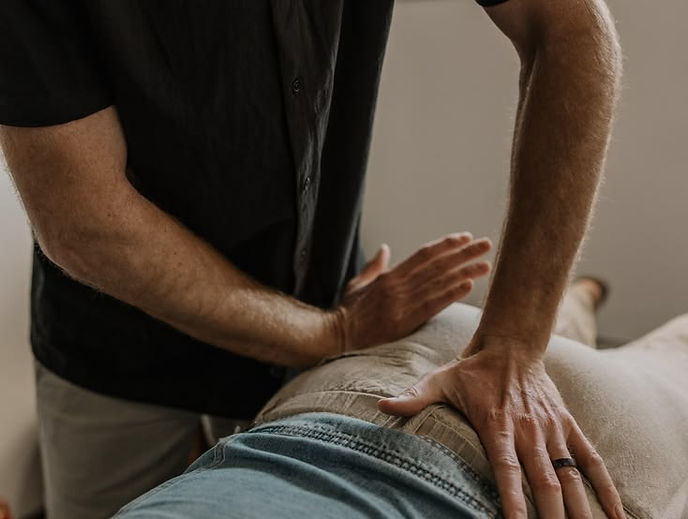
Lower back pain is one of those problems where the location of the pain can be almost misleading. Somebody points directly at the muscles beside the spine and says, "That is where it hurts." The natural assumption is that those muscles are the problem.
Sometimes they are. A muscle can absolutely be strained, injured, or overworked. But very often the painful muscle is the one trying to hold everything together because something else is not doing its job.
Back Spasm Does Not Always Mean the Back Muscle Is the Problem
A spasm is a protective response. If the body does not feel stable, it will create stability however it can. That may mean increased tension through the muscles beside the spine. The muscle that feels like a rock may be the muscle doing too much, not necessarily the muscle that started the problem.
This is one of the reasons I am careful about making the treatment goal simply "relax the tight muscle." If that muscle is acting as a brace because another part of the system is not supporting the spine, relaxing it without addressing the reason it tightened can produce only temporary relief.
The Psoas and the Front of the Spine
The psoas is one of the first muscles people hear about with low back pain. It attaches along the lumbar spine and travels through the pelvis to the upper femur. Because of that position, it influences the relationship between the lumbar spine, pelvis, and hip.
But I do not assume every psoas is simply "tight." A psoas can be overactive, inhibited, shortened, irritated, or compensating for poor stability somewhere else. The question is how it is functioning in that particular person and how the opposite hip, abdominal wall, and lumbar stabilizers are working with it.
Quadratus Lumborum, Glutes, and Pelvic Control
The quadratus lumborum, or QL, runs from the pelvis toward the lower ribs and lumbar spine. It helps control side bending and stabilizes the pelvis. If one side of the pelvis continually drops or hikes during walking, the QL can become chronically loaded.
The gluteus maximus and gluteus medius are equally important. If the glutes are not producing or controlling force well, the low back often has to absorb more movement. This becomes especially obvious when somebody stands on one leg, climbs stairs, gets up from a chair, or walks for a long period of time.
This is a common reason two people can have pain in nearly the same location but need completely different treatment. One may need better hip extension and gluteal control. Another may have a lumbar disc problem. Another may have a sacroiliac or pelvic loading problem.
I look at those same connections in my articles on pain on the outside of the hip and sciatica and pain down the leg. The location of the symptoms changes, but I still want to understand how the pieces are working together.
Do Not Forget the Abdominal Wall and Diaphragm
The abdominal wall is not just about having strong abs. The trunk has to create the right amount of pressure and stiffness at the right time. The diaphragm, pelvic floor, abdominal muscles, and spinal muscles all participate in that process.
Breathing mechanics can matter here. If someone is constantly breathing high into the chest and using accessory muscles instead of getting good expansion through the lower rib cage, their trunk strategy can change. That does not mean a breathing problem is the cause of every backache. It means that in some people it is one more piece of the mechanical picture that should be evaluated rather than ignored.
What I Am Looking For With an AK Approach
Applied Kinesiology gives me a way to look at muscle function inside the larger orthopedic exam. I want to know which muscles appear inhibited, which ones become hypertonic or painful as compensation, what happens after the patient moves, and whether changing a joint or movement pattern changes the muscle response.
The important part is the relationship. The original AK literature repeatedly emphasized the idea that a hypertonic muscle may sometimes be secondary to poor function of an antagonist. In practical terms, the muscle that hurts may be pulling hard because the muscle that should oppose or share the load is not contributing appropriately.
That concept is still useful as long as it is not turned into an absolute rule. Low back pain has many possible causes, including muscle and ligament strain, disc injury, arthritis, stenosis, fractures, inflammatory conditions, and other medical problems. A functional muscle assessment complements that differential diagnosis; it does not replace it.
That is also part of how I approach chiropractic care. I want the examination to guide what we work on, including the joints and muscles sharing the load with the low back.
When the Back Needs More Than Muscle Work
Pain following significant trauma, new bowel or bladder changes, saddle numbness, progressive leg weakness, fever, unexplained weight loss, a history of cancer, or severe pain that does not change with position deserves further medical evaluation. Imaging is not necessary for every backache, but it is important when the history and examination point toward a structural or neurologic problem.
The Takeaway
When a back muscle is tight, sore, or in spasm, do not stop the investigation at the painful tissue. Ask why that muscle is carrying so much tension. The psoas, QL, glutes, abdominal wall, diaphragm, pelvis, hips, and even the way the legs load during movement can change what the low back is being asked to do.
The goal is not simply to make a tight back muscle relax. The goal is to restore a system where it no longer has to work that hard in the first place.
If your back keeps tightening up and you have questions about where to start, you can book a free 15-minute consultation. We’ll talk through what you’ve been experiencing and whether our approach is a good fit for you.
About the author: Orie Quinn, D.C., is the founder and lead chiropractor at Ozark Holistic Center in Fayetteville, Arkansas.
Sources
American Academy of Orthopaedic Surgeons (AAOS), OrthoInfo. Low Back Pain. Updated April 27, 2026.
American Academy of Orthopaedic Surgeons (AAOS), OrthoInfo. Herniated Disk in the Lower Back. Updated April 27, 2026.
Walther DS. Applied Kinesiology Synopsis. 2nd ed. Systems DC; 2000.
Read the AAOS patient guide to low back pain, its causes, and evaluation.
